Medici Chapels of Florence: the RCC Oxygen Control Care system for the Argon-inertised crypt
Project under way on behalf of the Italian Ministry of Cultural Heritage — Medici Chapels of Florence. The crypt houses two showcases containing human remains preserved in a controlled Argon atmosphere. The RCC — Oxygen Control Care system, entirely designed, built, assembled and integrated by Hygiene Care R&D laboratories, continuously monitors O₂ concentration as an indirect indicator of Argon leakage, triggers multi-level alarms and — in emergency — automatically shuts the gas line via safety solenoid valve.
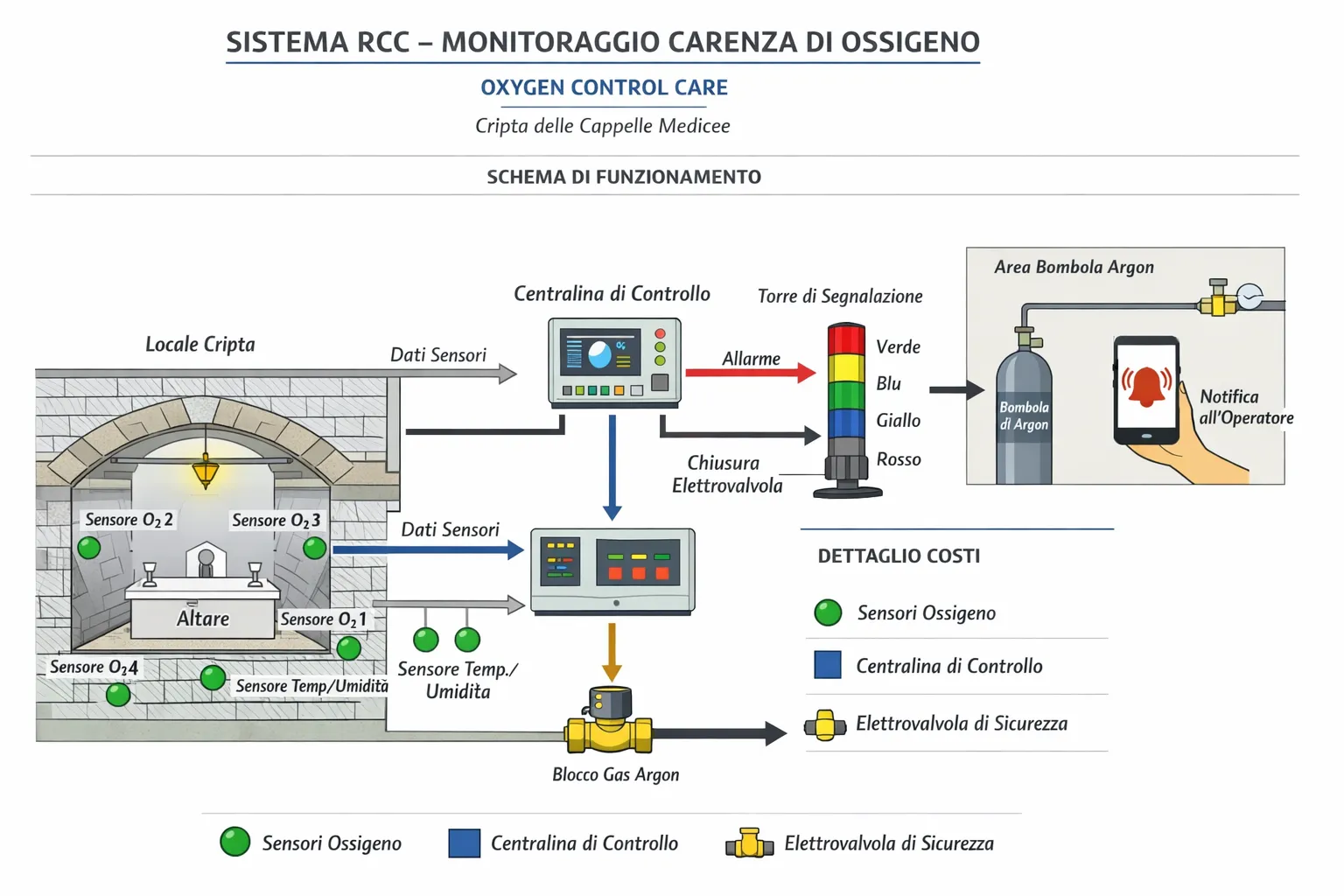
"Functional diagram of the RCC — Oxygen Control Care system: 4 O₂ sensors + T/RH sensor in the crypt, Raspberry Pi 5 controller, 4-colour signal tower, safety solenoid valve on the Argon line, operator app notification. Hygiene Care project for the Italian Ministry of Cultural Heritage."
Technical premise and criticalities
The crypt (~6.0 × 4.5 × 2.30 m, underground, no forced ventilation) hosts two sealed showcases inertised with Argon, an inert, colourless and odourless gas, heavier than air (density ≈ 1.38).
Supply pipes run at eye level (~1.50 m): the primary risk is a leak from joints with consequent displacement of ambient oxygen — Oxygen Deficiency Hazard (ODH).
Critical point: Argon, being heavier than air, stratifies and fills the room from the bottom up, making the risk invisible up to breathing level.
Upper room (above the trapdoor): large volume dilutes readings, but migration through the trapdoor can create O₂-poor zones at floor level near the opening, dangerous for operators upstairs.
RCC system architecture
O₂ sensors (5 detection points):
_Crypt:_
• O₂ sensor 1 — well (20 cm from floor, lowest area far from stairs): intercepts initial Argon stratification.
• O₂ sensor 2 — breathing level (140 cm, 1-2 m inside from entrance): protects operator on entry.
• O₂ sensor 3 — pipe sentinel (60-80 cm, near pipe path): detects O₂ drop before reaching breathing level.
• T/RH sensor: ambient temperature and relative humidity.
_Upper room (above the trapdoor):_
• O₂ sensor 4 — low near trapdoor (20-40 cm, 1-2 m from trapdoor): first stagnation signal.
• O₂ sensor 5 — breathing level near trapdoor (140 cm, 1-3 m from trapdoor): direct people-safety.
Sensor specs:
• Factory calibration · t63 < 2 sec
• Typical drift < 1% O₂/year at 21% O₂
• Useful life > 5 years · range 0-2000 hPa pO₂
• Technology tested and integrated by NASA on Mars Rover 2020
• Hydrophobic surface (water drops don't disturb)
• RoHS / REACH compliant · UART interface · 3.3 V / 8 mA
Control unit: Raspberry Pi 5 quad-core 64-bit, HAT expansion, A2 microSD 32-512 GB (-25 → +85 °C), certified USB-C PD 27 W power supply (5.1 V / 5 A, short-circuit + overload + overvoltage protection).
Output: 4-colour signal tower + sound alarm · mobile push notification · Hygiene Care cloud archive with signed data · safety solenoid valve on the Argon line that automatically blocks gas in emergency.
Safety procedures and alarm thresholds
Alarm thresholds (multi-level, with 4-colour light tower + buzzer + push notification):
• 🟢 GREEN — OK: O₂ ≥ 19.5%, system operative, showcase pressure nominal.
• 🟡 YELLOW — Pre-alarm: O₂ < 19.5%. Visual check, joint inspection.
• 🔴 RED — Alarm: O₂ < 18%. Access forbidden. Emergency forced ventilation.
• ⚫ EMERGENCY: O₂ < 17%. Total stop: automatic Argon solenoid valve closure + fire-brigade signal.
• 🔵 BLUE: separate showcase working-pressure indicator (technical sub-alarm for minor leaks).
Mandatory access procedure:
1. Preventive measurement of O₂ via display at staircase entrance (inherits underground top-sensor reading).
2. Tower verification at top of stairs: if not GREEN, do not enter.
3. Keep company phone active with Hygiene Care RCC app: real-time alarms during stay.
4. Maximum stay time in crypt logged by the system; over threshold, supervisor notification.
Archive and traceability: every reading is written on local microSD and replicated on encrypted Hygiene Care cloud. Digitally signed data, kept minimum 12 months, exportable as signed PDF for Ministry, ASL and fire brigade.
Our approach and 24/7 operation
System operation (automatic, continuous, no operator intervention):
1. Sensors measure O₂, temperature and RH at strategic points.
2. Data acquired by Raspberry Pi 5 controller, filtered (proprietary noise-rejection algorithm) and processed every 2 seconds.
3. Real-time transmission via Ethernet/Wi-Fi to encrypted AES-256 Hygiene Care cloud.
4. Readings compared with configured thresholds; if exceeded, tower + siren + push activation.
5. In emergency, the controller sends the solenoid valve closure command on the Argon line (latency < 1 sec).
6. Simultaneous notification to: on-duty operator, Hygiene Care technical manager, Ministry referent.
7. Data accessible via web dashboard and mobile app.
Maintenance:
• Quarterly functional on-site verification.
• Annual one-point user calibration (in air).
• Continuous remote sensor-status monitoring with separate fault alarm (signals hardware failures independent of O₂ value).
• Preventive sensor replacement after 5 years or when drift > 1.5%.
Technical conclusion: monitoring oxygen concentration as an indirect indicator of Argon leakage is technically correct and consistent with international inert-gas safety practice (EIGA, IGC Doc 44, EN 50104 standards). The choice of industrial-grade Raspberry Pi 5, NASA-tested sensors and automatic shutoff solenoid valve makes the RCC system a fail-safe security solution dedicated to Italian historical-cultural heritage.
*See the functional diagram above for the complete data → controller → output → operator app flow.*
Want to be compliant without worries?
Free site visit, transparent quote within 48 working hours, ongoing support with digital deadline tracker.
● Consultation request
Let's talk.
Fill in the form: a technician will get back to you within 24 working hours with an initial assessment and an indicative quote.
Via degli Artigiani 27
Via degli Artigiani 27 — 50055 Lastra a Signa (FI), Italy