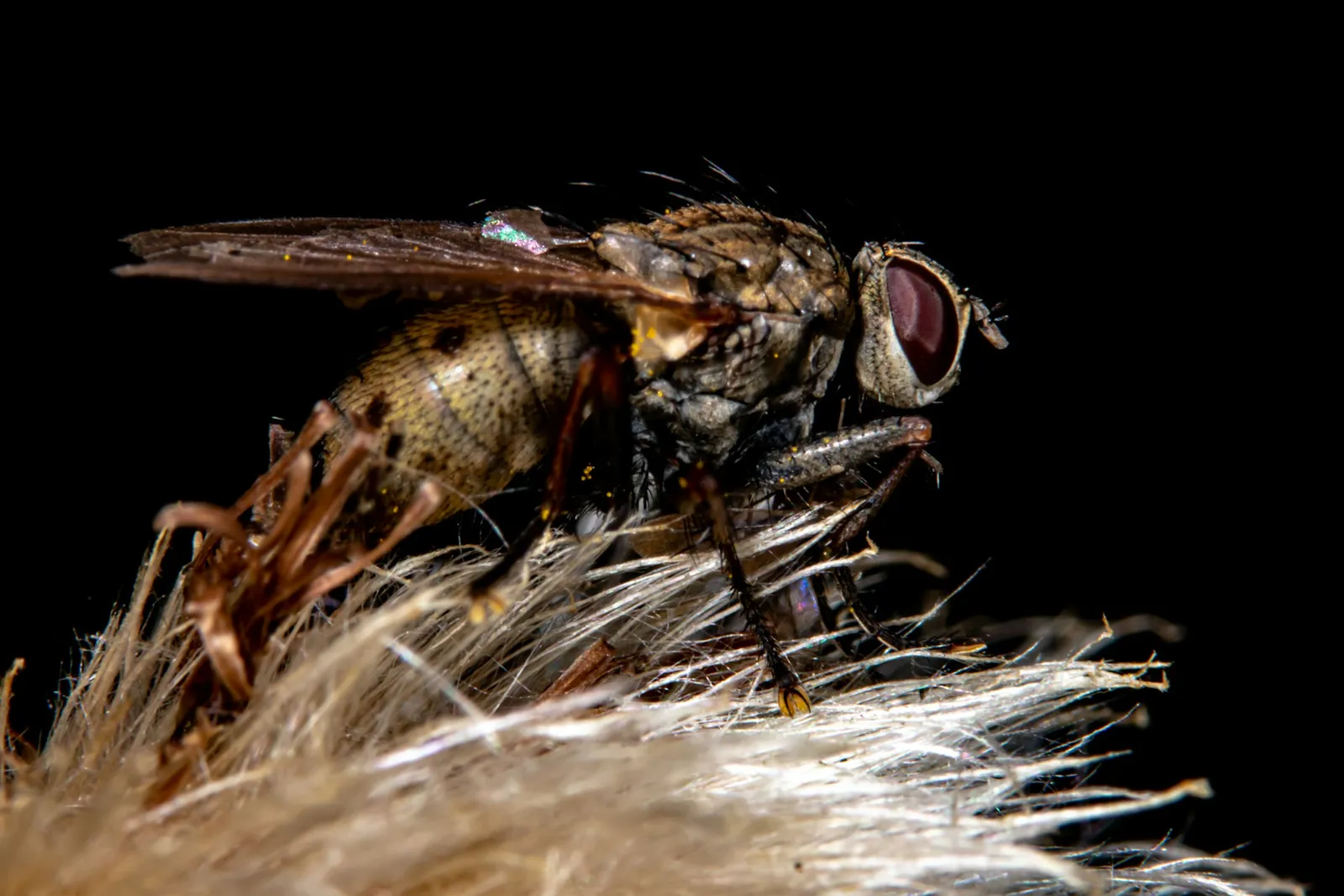
The wood-borer parasitic mite that attacks humans
Pyemotes ventricosus is a microscopic mite (0.2 mm) parasitic on wood-borer larvae. When the wood-borer infestation is massive and Pyemotes can no longer find hosts, they accidentally attack humans causing severe dermatitis, violent itching and in sensitive subjects systemic allergic reactions.

"Pyemotes ventricosus bites produce itchy papules, often with the characteristic 'comet' shape or central vesicle."
Biology & life cycle
Appearance: 0.2–0.25 mm, yellow-amber, invisible to the naked eye. Gravid female swells to spherical shape (characteristic “ventricosus”), 1–2 mm.
Life cycle: extremely fast. A gravid female directly releases 200–300 already fertilized adult offspring in 7–10 days. No external eggs or free juvenile stages.
Behaviour: paralyses wood-borer larvae with neurotoxin venom. When population explodes and wood-borer larvae decrease, it migrates in search of new hosts — that's when it strikes humans.
Vector: doesn't live on people or clothes, bites during passage. Accidental, exhausting after a few hours of contact.
Where they develop
Where it's found:
• Wood-borer infested beams in country houses, barns, lofts, renovated farmhouses.
• Antique wood-borer infested furniture in poorly ventilated rooms.
• Old firewood stacks kept indoors or near walls.
• Paper archives with bookworms.
• Restoration sites working with old wood.
Most affected: restorers, carpenters, librarians, rural house dwellers, antiquarians, those sleeping near antique furniture.
Diseases & risks
Pyemotes ventricosus doesn't significantly transmit pathogenic viruses or bacteria, but the clinical issue is intense allergic and inflammatory reaction to saliva and paralysing venom injected during the bite.
In occupational health it's considered a biological risk under Title X of D.Lgs. 81/08 for restorers, carpenters, archivists working with infested wood/documents.
Cases in Italy
Italy:
• Documented episodes in many cities (Florence, Bologna, Rome, Milan, Padua, Palermo) linked to country houses, lofts, antique furniture.
• Typical family clusters on holiday in renovated farmhouses with infested beams.
• Rise after exposed-beam renovation waves (2000–2020) reintroducing infested wood into heated homes.
• University of Perugia research confirmed spread in Italy.
• Often misdiagnosed as scabies or unspecified allergy until the source (wood) is found.
Allergic manifestations
Clinical manifestations ("woodworm dermatitis" or "summer dermatitis"):
• Main cutaneous symptoms:
– Itchy erythematous papules, often with translucent central vesicle.
– Characteristic "comet" shape (papule + erythematous trail) considered pathognomonic.
– Violent itching, persistent 4–14 days.
– Lesions especially on neck, trunk, limbs, clothed areas (mites bite while crawling under clothes).
– Sometimes true vesicles with serous exudate.
• Systemic allergic reactions (sensitive subjects or massive exposure):
– Diffuse urticaria-like eruption.
– Mild fever.
– Headache, malaise, muscle and back pain.
– Respiratory symptoms: dry cough, dyspnoea, asthma attacks.
– Anaphylactic shock: rare but documented.
• Differential diagnosis: often confused with scabies, bedbug bites, atopic dermatitis, chickenpox, herpes zoster. Correct diagnosis requires identifying the source.
• Medical treatment: oral antihistamines (cetirizine, loratadine), topical corticosteroids, don't scratch.
How to recognise the infestation
How to recognise the problem:
• Bites concentrated on trunk, limbs, neck, appearing hours after contact (not immediate like mosquitoes).
• Different family members affected simultaneously.
• Worsening entering country house or room with antique furniture; improvement moving away.
• Confirmed presence of wood-borers (holes, sawdust) in frequented spaces.
• Pets may also show skin papules.
• Lesions lasting days instead of hours.
• Poor or no response to standard anti-scabies treatments.
Call us for a site visit
Every infestation has its own species, biology and intervention strategy. Don't improvise: contact us for a free site visit. Within 48 working hours you receive a precise technical assessment and a transparent quote, drafted by Dr. Marco Tarducci and the Hygiene Care team.
📞 Phone · 💬 WhatsApp · ✉️ Email — all contacts at the bottom of the page.
Our approach
Our Pyemotes protocol:
• Free, prompt site visit to identify the source.
• Identification of wood-borer host species.
• Targeted treatment of infested wood with nitrogen anoxia (furniture/art) or microwave/controlled heat/specific biocides (structural beams).
• Cleaning of surrounding environments.
• Post-treatment monitoring with sticky traps at 30, 60, 90 days.
• Technical report with photos, species ID, active ingredient and efficacy times (useful for doctor and insurance).
• Coordination with doctor or dermatologist if needed.
The problem only solves by eliminating host wood-borers.
Seasonality
Manifestations especially May to October when temperature and humidity favour Pyemotes development. But in heated houses can appear even in winter.
Noticed any of the symptoms above? Don't wait.
Site visit is free and for urgent cases we intervene within 24–48 working hours. The sooner we act, the faster the resolution.
● Consultation request
Let's talk.
Fill in the form: a technician will get back to you within 24 working hours with an initial assessment and an indicative quote.
Via degli Artigiani 27
Via degli Artigiani 27 — 50055 Lastra a Signa (FI), Italy