Cockroaches: German, Oriental, American
Pheromone attractant traps and targeted new-generation food gels. Cockroaches are among the most serious HACCP risks: pathogens, allergens, exponential multiplication.
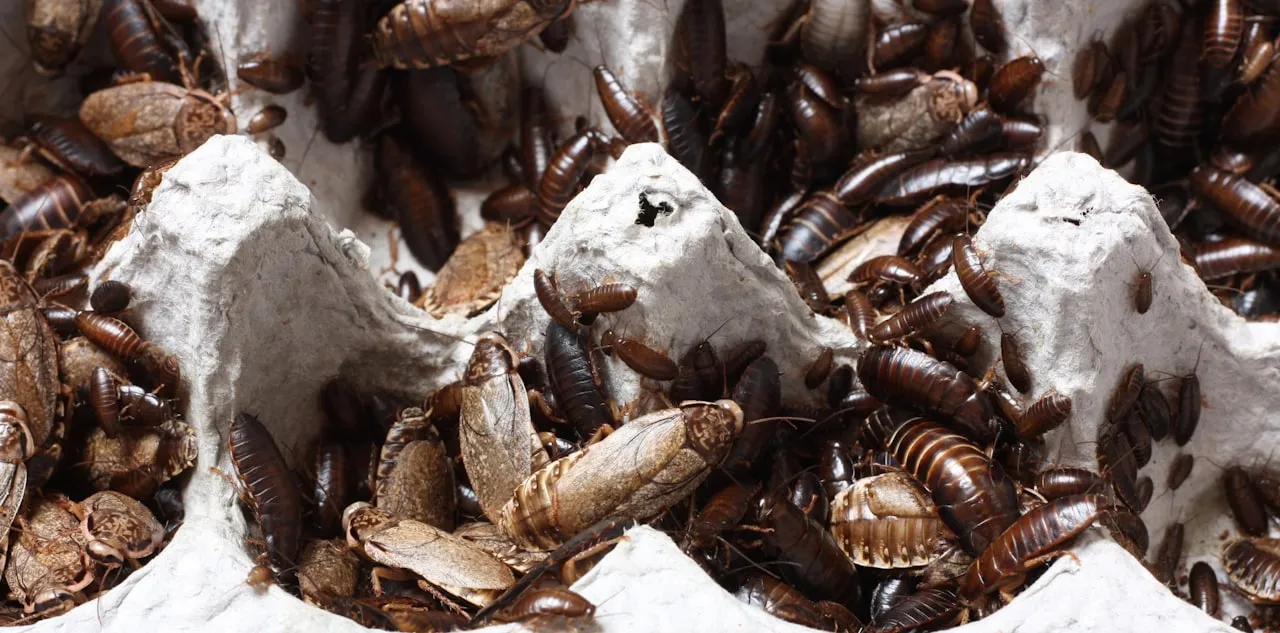
"Cockroaches nest in the 20 cm closest to fridges, dishwashers and cold-counter motors: warm and damp points."
Biology & life cycle
German cockroach (Blattella germanica): 12–15 mm honey colour with two dark bands. Cycle: egg (ootheca with 30–40 eggs) → 5–7 nymphal stages → adult, ~60 days. Female carries ootheca attached. A single pair can generate over 10,000 descendants/year.
Oriental cockroach (Blatta orientalis): 20–25 mm, black, cooler/damper. Cycle 300–500 days. Ootheca with 16 eggs.
American cockroach (Periplaneta americana): 30–40 mm reddish-brown, flies. Cycle 400–600 days.
Brown-banded cockroach (Supella longipalpa): 10–14 mm, prefers bedrooms.
Where they develop
German: anywhere with heat + moisture + food. Within 20 cm of fridges, dishwashers, fryers, cold-counter motors, traps, under sinks, inside warm electronics.
Oriental: drains, sewers, cellars, damp cavities, waste rooms.
American: technical tanks, boiler rooms, crawl spaces.
Brown-banded: books, lamps, bedroom furnishings.
Active at night.
Diseases & risks
Mechanical vectors of Salmonella, Shigella, E. coli, Listeria, S. aureus, Pseudomonas, Klebsiella, Streptococcus, plus fungi and protozoa.
Carry helminth eggs and poliovirus.
Exuviae and body fragments contain potent allergens (Bla g 1, Bla g 2) linked to asthma and allergic rhinitis. Primary cause of paediatric asthma in urban environments.
In HACCP: serious non-compliance → product recall, suspension, penalties.
Cases in Italy
Italy:
• Cockroaches: top cause of HACCP sanctions in catering after missing self-control manual.
• Marked rise in past 5 years in urban areas.
• Paediatric allergic asthma: 10% of school-age children in Italy; cockroach link documented in Rome and Milan.
• Viral cases of insects found in fast-food chains with 6-figure reputational damage.
How to recognise the infestation
Daytime sightings = advanced infestation. Empty oothecae shaped like dark brown coffee beans. Black dotted spots (droppings). Characteristic sweet acrid smell. Translucent exuviae. Gnawing marks on paper and food.
Call us for a site visit
Every infestation has its own species, biology and intervention strategy. Don't improvise: contact us for a free site visit. Within 48 working hours you receive a precise technical assessment and a transparent quote, drafted by Dr. Marco Tarducci and the Hygiene Care team.
📞 Phone · 💬 WhatsApp · ✉️ Email — all contacts at the bottom of the page.
Our approach
Zero-tolerance protocol for food environments:
• Night inspection with red torch and flushing.
• Pheromone traps at 15–25 key points.
• Latest-generation food-safe insecticidal gels (fipronil, indoxacarb, dinotefuran).
• Domino effect: kills the colony in 7–14 days.
• 3 cycles 10–14 days apart.
• Verification with traps + photo report.
Never residual fogging in kitchens.
Seasonality
Year-round in heated environments. Development peaks late summer.
Noticed any of the symptoms above? Don't wait.
Site visit is free and for urgent cases we intervene within 24–48 working hours. The sooner we act, the faster the resolution.
● Consultation request
Let's talk.
Fill in the form: a technician will get back to you within 24 working hours with an initial assessment and an indicative quote.
Via degli Artigiani 27
Via degli Artigiani 27 — 50055 Lastra a Signa (FI), Italy